Allergic Rhinitis (1) - Definition, Causes & Symptoms

WEST Vs EAST
- Allergic Rhinitis definition, causes & symptoms
Allergic Rhinitis : Definition
Western Medicine
Allergic rhinitis is a condition that presents frequent attacks of sneezing, nasal discharge or blockage of the nasal passages. It may be seasonal (a limited period of the year) or perennial (throughout the whole year).
Seasonal rhinitis is often called "hay fever" and is the most common of all allergic diseases, about 2 to 20 per cent of the population worldwide are thought to be affected. Teenagers experience the highest prevalence, with up to 30% of young people showing symptoms during the summer months.
Chinese Medicine
Traditional Chinese Medicine (TCM) has a long history of managing hay fever, with symptoms documented as early as 2000 years ago. The Yellow Emperor’s Classic of Internal Medicine provides detailed descriptions of symptoms like nasal congestion, nasal itchiness, sneezing, and clear nasal discharges, which align closely with modern understandings of hay fever.
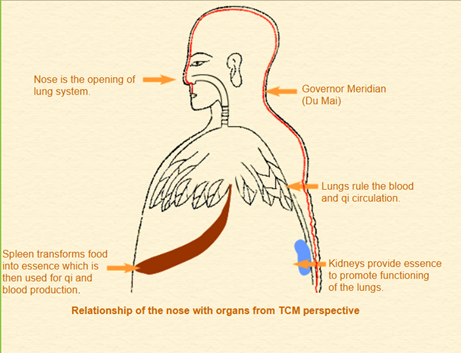
The nose is responsible for breathing, smelling, and aiding pronunciation. From a TCM perspective, nasal functioning closely relies on the support and regulation of internal organs and meridians. TCM regards the nose as an orifice of the lungs on the body surface, the external portal for gas exchange. When lung qi is abundant, the nasal passages remain clear, with a keen sense of smell and smooth breathing. Conversely, lung disharmony can lead to nasal congestion, a runny nose, or a decreased sense of smell. Therefore, TCM treatments often aim to regulate and strengthen lung functioning to improve nasal health.
The spleen is responsible for nutrient essence production, and the kidneys are responsible for essence storage of the body; both organs are critical for proper nasal functioning too.
Beside the Lung meridian, the Governor Vessel meridian runs across the midline of the front head, passing through the nose vertically. The acupoint, ying xiang (LI 20, located at the outer edge of the nostril) is the starting point of the Large Intestine meridian and the endpoint of the Stomach meridian. These meridians are closely associated with acupuncture therapy for nose problems.
Allergic Rhinitis : Causes
Western Medicine
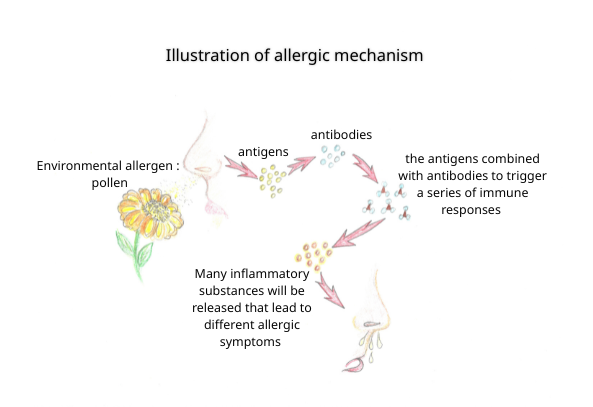
Allergic rhinitis, also known as hay fever, involves inflammation of the nose, sinuses, and eyes. The allergic reaction occurs when the body’s immune system overreacts to allergens such as pollen, dust mites, mold, or pet dander, that are usually harmless. The immune system mistakenly identifies the harmful antigens, and the response leads to the release of histamines and other chemicals, causing inflammation and allergic symptoms. Doctors usually divide the disorder into two categories:
- Perennial allergic rhinitis
Chinese Medicine
TCM claims that the development of allergic rhinitis has internal and external aspects.
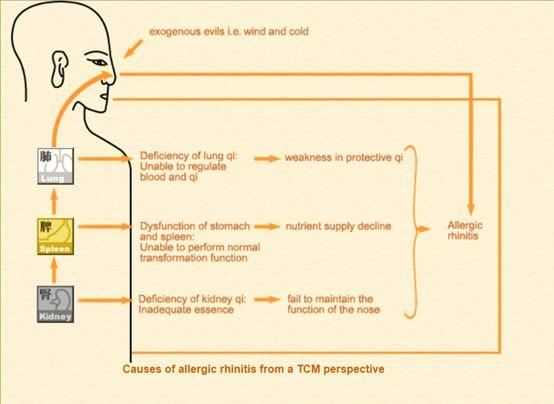
A deficiency inherited at birth, chronic illness, over-exertion, improper diet, or emotional distress can all damage internal organs. Under-functioning of organs and depletion of blood and qi (vital energy) make the body susceptible to illness. For allergic rhinitis, organs like the lungs, spleen, and kidney are mainly associated with the internal deficiency of the rhinitis.
- Lung deficiency: The nose is considered as the external opening of the lungs, usually known as nasal orifices; a lung deficiency leads to weakened nasal functioning. Lung deficiency also leads to weak protective qi, making the exogenous evils invade the nose orifice more easily. The result will be recurring episodes of nasal problems, such as congestion, watery discharges and sneezing.
- Weak stomach and spleen: The spleen and stomach are responsible for transformation and transportation of nutrient essence for the body. When the functions become weak, there will be a decline in qi and blood internally, and the nose will lose its supply of nutrient. This reflects a disorder in the nasal linings (mucous membranes), leading to nasal obstruction, watery discharge, and sneezing. The sense of smell is also affected too.
- Kidney deficiency: Normally, the kidney assists the lungs in ruling qi movements and body fluid distribution inside the body. Kidney deficiency can distribute qi activities and fluid distribution, and also affect the essence supply to the nose, leading to nose problems such as pale and swollen nasal linings, frequent episodes of nasal itching, sneezing, and watery discharges from nose.
(II) Invasion of exogenous evils (external aspect)
The nose is located at the center of the face, representing the most yang part of the body, and the region receives abundant blood flow. Wind evil is the leading cause of many illnesses, often bringing other exogenous pathogens along and likely attacking the nose. Therefore, nasal symptoms are very common in exogenous diseases.
From a TCM perspective, hay fever is usually resulted from a combination of external pathogens and body weakness. When the body is weak and the protective qi is not strong, exogenous pathogens take advantage of the chance and attack the body. Additionally, the extent of influence from internal and external factors determines the development of hay fever. Their roles vary in each case and even during specific episodes. Generally, new cases or acute attacks are primarily influenced by external factors, while chronic or recurring episodes are mainly influenced by internal factors.
Allergic Rhinitis : Symptoms
Western Medicine
Seasonal allergic rhinitis has the following features:
- Frequent sudden attacks of sneezing, with profuse watery nasal discharge and nasal obstruction.
- Each time, the attack only lasts for a few hours, and is often accompanied by sharp pain, watery and pink eyes (conjunctivitis).
- Some individuals may have conjunctivitis without nasal symptoms.
- The condition does not cause fever.
- Swelling of the nasal linings may lead to headaches, due to a build-up of pressure in the nasal passages and sinuses.
Symptoms are similar but tend to be more continuous and generally less severe. It's not surprising that individuals with multiple clinical sensitivities often experience perennial rhinitis along with one or more predictable seasonal flare-ups, and so vary in severity.
Individuals usually don't cause dramatic symptoms. However, a persistently blocked nose can lead to complications like mouth breathing, snoring, and a dry throat. Dark circles and puffiness can develop under the eyes. Swollen mucous membranes can easily get infected and further cause recurrent or chronic sinusitis. Drainage from nasal infections can lead to a sore throat and bronchitis. In children, when the eustachian tubes are blocked by swollen mucous membranes, enlarged adenoids, or excess discharges, there can be ear problems like temporary deafness and recurrent middle ear infections.
While individuals with allergic rhinitis tend to develop bronchial asthma more frequently than the general population, the exact increase in risk is not well-defined. Generally, the risk of developing asthma increases with the severity of rhinitis, especially if chronic sinusitis and bronchial infections are present, or if the individual has had asthma attacks in the past.
Chinese Medicine
During a consultation, TCM physicians rely on the four examination skills to collect clinical information for diagnosis. The information will be grouped into a syndrome or disharmony pattern and then used for planning treatment. It should be noted that a disharmony pattern only indicates certain pathological stages of a disease, therefore it is necessary to adjust the treatment during disease development. The following are common disharmony patterns for allergic rhinitis:
1. Wind-cold attacking lungs
Nasal itching, sneezing, nasal congestion, and watery discharges, the symptoms are usually triggered by being exposed to windy weather or a cold temperature in the morning. Other accompanied signs include pallor, shortness of breath, ease of sweating on exertion, and aversion to cold.
2. Lung and spleen deficiencies leading to dampness accumulated
Sneezing, watery nasal discharge and moderately severe nasal congestion, other accompanied signs may include heaviness in the forehead or a pounding pain between the eyebrows, a loss of sense of smell, fatigue, shortness of breath, aversion to cold, limb heaviness, abdominal fullness, a poor appetite, and diarrhea.
3. Kidney yang depletion failing to support and warm lungs
Nasal congestion, sneezing with watery discharge, aversion to cold, and cold limbs, the symptoms usually occur after a cold sensation in the shoulders and back. Other accompanied symptoms include dizziness, ear ringing, night frequency, impotence or premature ejaculation, and a hot sensation in the palms and soles of the feet.
4. Spleen deficiency and phlegm obstruction
Severe nasal congestion, copious watery discharge, and nasal itching. On examination, the nasal linings swollen obviously. There may also occur heaviness in the forehead, limb weakness, fullness in the chest and gastric regions, copious white sticky sputum in the throat, poor appetite, and diarrhea.
5. Wind-heat attacking lungs
Frequent sneezing, nasal itching, and severe congestion, the runny nose will be serious when further stimulated by foreign objects or warm temperatures. Individuals often exhibit a pattern of alternating relapse and remission. The other accompanied symptoms include fever, aversion to cold, headache, and sweating.
Allergic Rhinitis : References
Western Medicine
- Chapel HM, Haeney MR, Misbath A, et al. Essentials of Clinical Immunology, 4th ed. Oxford: Blackwell Science, 1999: 224-5.
- Crompton GK, Haslett C. Diseases of the respiratory system. In: Edwards CRW, Boucher IAD, Haslett C, et al, eds. Davidson's Principles and Practice of Medicine, 17th ed. Edinburgh: Churchill Livingstone, 1995:393.
- Rusznak C, Davies RJ. ABC of allergies. British Medical Journal 1998;316:686-9.
Chinese Medicine
- Chen Guo-feng, ed, Gan's E.N.T. & Stomatology, Jiang Su Science and Technology Publishing Co Ltd, 1999:183.
- Wang min-yu. 315 allergic rhinitis clinical cases treated by infusion for evacuating wind evils and promoting blood circulation. Zhejiang Chinese Medicine Journal 1992;27(7):310.
- Wu Cheng-shan. Exploring allergic rhinitis in treating phlegm and dampness evils. Shan Xi Chinese Medicine 1996;17(12):544-5.
- Zhang En-qin. Clinical Medicines of Traditional Chinese Medicine. Publishing House of Shanghai College of TCM, 1990:7.
Written and Edited By:
Western Medicine
Dr Lily Holman MB MSc PhD
Senior Lecturer, Middlesex University, London, UK.
Chinese Medicine
Dang Yi (黨毅) MD PhD
Professor, Beijing University of Chinese Medicine; Visiting Professor, Middlesex University,
London, UK; Vice Director, Gourmet Food Institute of Health Care and Nutrition of Beijing, PRC.
Translations
Rose Tse, Integrated Chinese Medicine Holdings Ltd.
Editors
Angela Collingwood, MSN Integrated Chinese Medicine Holdings Ltd.
Carol Dyer, BPharm, MRPharms, Integrated Chinese Medicine Holdings Ltd.
Rose Tse, Integrated Chinese Medicine Holdings Ltd.